
Ultrasonic Welders for Metal
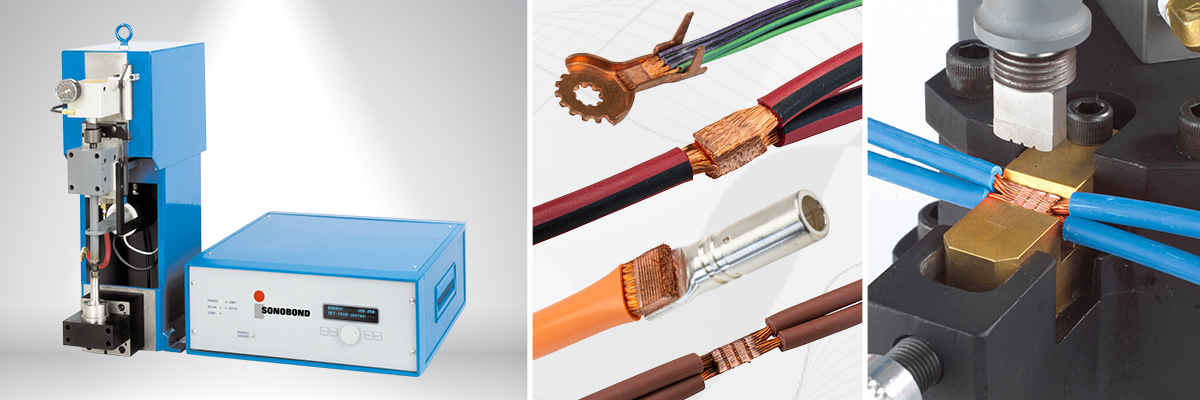
Produce Strong, Precise, Solid-State Metal Welds
Sonobond ultrasonic welders create strong, repeatable solid-state metallurgical bonds without heat, current, solder or filler materials. Using high-frequency mechanical vibrations, our ultrasonic welding machines permanently join conductive metals while preserving their electrical conductivity and mechanical strength.
Unlike conventional welding methods, ultrasonic metal welding does not melt the base materials. Instead, it produces clean, reliable metallurgical bonds through controlled pressure and ultrasonic energy. Manufacturers worldwide rely on Sonobond ultrasonic welders for wire splicing, battery assembly, wire-to-terminal welding, foil welding and other critical applications requiring fast, consistent, high-quality results.
What Are Ultrasonic Welders?
Ultrasonic welders are advanced manufacturing systems that join non-ferrous metals using high-frequency mechanical vibrations and controlled pressure. The process creates a solid-state metallurgical bond without melting the materials, making it ideal for copper, aluminum, brass, nickel alloys and many dissimilar metal combinations.
Because ultrasonic welding requires no heat, solder, flux or filler materials, manufacturers benefit from cleaner joints, shorter production cycles and highly repeatable weld quality. The process also minimizes oxidation, thermal distortion and damage to sensitive components.
Benefits of Sonobond Ultrasonic Welders
Sonobond ultrasonic welders help manufacturers improve quality, productivity and reliability across a wide range of metal joining applications.Benefits include:
- Lower operating costs by eliminating consumable materials
- Produce strong, solid-state metallurgical bonds
- Eliminate solder, flux and filler materials
- Preserve excellent electrical and thermal conductivity
- Weld tinned and oxidized metals without pre-cleaning
- Join similar and dissimilar non-ferrous metals
- Weld thin-to-thin and thin-to-thick materials
- Reduce cycle times and increase production throughput
- Deliver highly repeatable, consistent weld quality
- Minimize thermal distortion and material damage
- Integrate easily into automated manufacturing systems
Why Choose Sonobond?
For more than 60 years, Sonobond has been a leader in ultrasonic metal welding technology. Our application engineers work closely with manufacturers to develop reliable welding solutions for challenging production environments. Sonobond ultrasonic welders offer:
- Automation-ready equipment for modern production lines
- Proven ultrasonic welding technology
- Patented Wedge-Reed® system for superior weld performance
- Equipment manufactured in the USA
- Laboratory, pilot-production and high-volume manufacturing systems
- Standard and custom tooling
- Application development and engineering support
Sonobond Ultrasonic Welding Models
| SpliceRite™ Ultrasonic Wire Splicer | |
| SonoWeld® Ultrasonic Metal Spot Welder | |
| WeldMAX™ Ultrasonic Spot Welder |
Top Applications for Ultrasonic Welding
Sonobond ultrasonic welders are used across numerous industries where reliable electrical and mechanical connections are essential. Sonobond ultrasonic welders offer:
Wire Splicing
Produce strong, low-resistance wire splices for automotive wiring harnesses, industrial controls, aerospace systems and electrical assemblies. Sonobond welders can join stranded, solid, tinned and dissimilar wire combinations with exceptional consistency.
Wire-to-Terminal Welding
Create permanent electrical connections between wires and terminals without crimping, soldering or additional consumables, improving conductivity and long-term reliability.
Battery Assembly
Manufacture dependable battery tab, bus bar and terminal connections for lithium-ion batteries, electric vehicles, energy storage systems and consumer electronics.
Foil and Bus Bar Welding
Join thin metal foils and bus bars while preserving electrical conductivity and minimizing material distortion.
Electrical Connectors
Produce consistent, high-strength welds for connectors, switches, sensors and other electrical components requiring reliable performance.
Solar and Renewable Energy
Create durable electrical interconnections for photovoltaic modules, battery systems and renewable energy equipment.
Aerospace and Defense
Manufacture lightweight, high-reliability electrical assemblies for demanding aerospace and military applications.
Why Manufacturers Choose Ultrasonic Welders Instead of Conventional Joining Methods
Compared to resistance welding, soldering and crimping, ultrasonic welders provide several significant advantages.
| Ultrasonic Welders | Conventional Joining Methods |
|---|---|
| No heat required | Heat often required |
| No solder or flux | Often requires consumables |
| Excellent electrical conductivity | Conductivity may be reduced |
| Minimal thermal distortion | Greater heat-affected zones |
| Fast production cycles | Slower processing |
| Highly repeatable weld quality | Greater process variability |
| Automation-friendly | Often more labor intensive |
Click here to download Sonobond’s free Ultrasonic Metal Welding Primer. It contains an in-depth explanation of the process and principles involved in ultrasonic metal welding, as well as helpful information about equipment and applications.
Frequently Asked Questions about Ultrasonic Welders
What are ultrasonic welders?
Ultrasonic welders are machines that join metals using high-frequency mechanical vibrations and pressure rather than heat, solder or filler materials. The process creates strong, solid-state metallurgical bonds with excellent electrical conductivity.
What metals can ultrasonic welders join?
Ultrasonic welders are commonly used to join copper, aluminum, brass, nickel alloys and many dissimilar non-ferrous metal combinations. They are especially effective for electrical conductors and battery components.
What are the advantages of ultrasonic metal welding?
Ultrasonic metal welding eliminates heat, solder and flux while producing fast, repeatable welds with excellent electrical and mechanical performance. It also reduces consumable costs and supports automated manufacturing.
Can ultrasonic welders join tinned wire?
Yes. Sonobond ultrasonic welders can weld tinned wire without removing the tin coating, reducing preparation time while maintaining strong, reliable electrical connections.
Which industries use ultrasonic welders?
Ultrasonic welders are widely used in automotive, aerospace, battery manufacturing, medical devices, renewable energy, industrial equipment, electrical assemblies and consumer electronics.
Can ultrasonic welders join dissimilar metals?
Yes. Ultrasonic welding is particularly effective for joining many combinations of dissimilar non-ferrous metals, making it an ideal solution for electrical and electronic manufacturing.