
Ultrasonic Fabric Welding Machines for Nonwovens and Technical Textiles
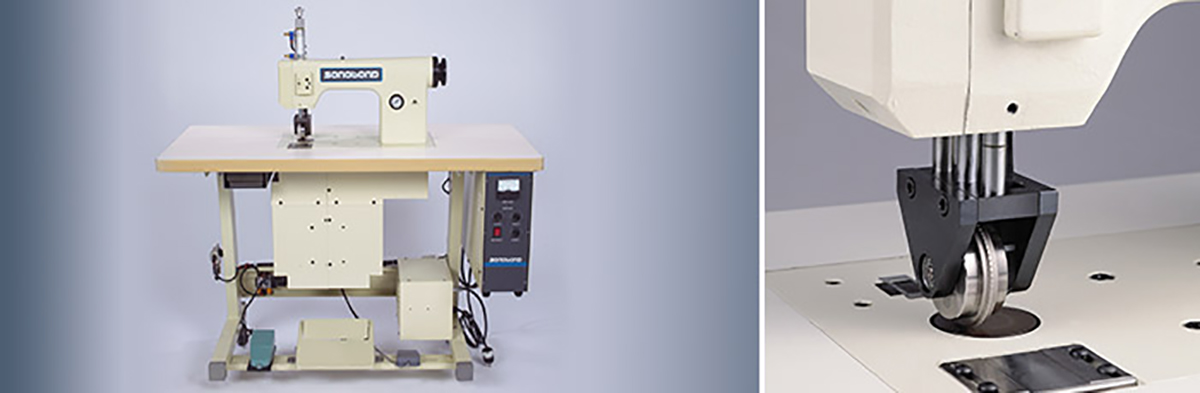
Create Fast, Secure Bonds
Manufacturers around the world rely on ultrasonic fabric welding to produce stronger, cleaner seams without thread, adhesives or other consumables. Using high-frequency ultrasonic vibrations, Sonobond ultrasonic fabric welding machines create durable, leak-resistant bonds in synthetic fabrics and nonwoven materials while increasing production speed, improving product quality and reducing manufacturing costs.
Whether you’re producing medical products, filtration media, automotive components or industrial textiles, Sonobond delivers proven ultrasonic welding technology that helps you manufacture more efficiently and consistently.
What is Ultrasonic Fabric Welding?
Ultrasonic fabric welding is a process that permanently joins synthetic fabrics and nonwoven materials using high-frequency mechanical vibrations. The ultrasonic energy generates localized heat at the bond line, causing the fibers to fuse together without damaging the surrounding material.
Unlike conventional sewing, ultrasonic welding creates continuous sealed seams without needle holes, thread or adhesives. The result is stronger, cleaner welds with improved appearance, greater consistency and enhanced product performance.
Benefits of Ultrasonic Fabric Welding
Sonobond ultrasonic fabric welding machines help manufacturers improve productivity while producing high-quality welded seams.
- Weld seams up to four times faster than conventional sewing
- Eliminate thread, adhesives and other consumables
- Produce clean, consistent seams with no needle holes
- Create strong, leak-resistant welds for demanding applications
- Reduce material waste and manufacturing costsImprove product consistency and repeatability
- Support automated, high-volume productionLower maintenance requirements compared to traditional sewing operations
- Support sustainability initiatives by reducing material consumption and waste
- Seal the outer shell of body armor to meet NIJ standards.
- Eliminate stitch holes and glue gaps in liquid and air filters, including HEPA filters.
Why Choose Sonobond?
For more than 60 years, manufacturers have trusted Sonobond for innovative ultrasonic welding solutions. Our application engineers work closely with customers to develop equipment that delivers reliable, repeatable weld quality for even the most demanding production environments. Sonobond systems feature:
- Proven ultrasonic welding technology
- Patented Wedge-Reed® technology for superior weld performance
- Equipment manufactured in the USA
- Standard and custom tooling options
- Application development and engineering support
- Machines designed for laboratory, pilot and full-scale production
Applications for Ultrasonic Fabric Welding
Sonobond ultrasonic fabric welding equipment is used across a wide range of industries where strong, precise seams are essential.
- Medical and Personal Protective Equipment (PPE): Produce leak-resistant seams for surgical gowns, face masks, protective apparel, drapes and other disposable medical products without compromising barrier integrity.
- Filtration Products: Create clean, durable seams in filter media without introducing adhesives or contaminants that could affect filtration performance. Includes pleated, HVAC, and HEPA filters, as well as air, liquid, and gas filters for automotive and aerospace applications.
- Dry Bags: Since seams are stronger and created without perforations, bags remain waterproof and durable while avoiding additional sealing materials.
- Protective Gear: Since seams are created without perforations; ballistic-resistant materials are protected from water exposure, and consumables like thread and adhesives are not used.
Explore our Ultrasonic Bonding Models
How Ultrasonic Fabric Welding Works
Ultrasonic fabric welding uses high-frequency mechanical vibrations to generate heat only where the materials are joined. The process consists of five simple steps:
- Two layers of thermoplastic fabric are positioned together.
- An ultrasonic horn applies high-frequency vibrations.
- Localized heat softens the material at the weld interface.
- Pressure permanently fuses the materials together.
- The welded seam cools almost instantly, producing a strong, durable bond.
Because heat is generated only at the weld location, surrounding material experiences minimal thermal distortion, helping preserve the appearance and performance of the finished product.
Ultrasonic Welding vs. Conventional Sewing
Compared to traditional sewing, ultrasonic fabric welding offers significant manufacturing advantages.
| Ultrasonic Fabric Welding | Conventional Sewing |
|---|---|
| No thread required | Requires thread |
| No needle holes | Needle holes may weaken barrier protection |
| No adhesives required | Adhesives may be required for sealing |
| Faster production speeds | Slower mechanical process |
| Consistent automated welds | Greater operator variability |
| Reduced material waste | Higher consumable usage |
| Excellent for automation | More labor intensive |
Frequently Asked Questions about Ultrasonic Fabric Welding
What is ultrasonic fabric welding?
Ultrasonic fabric welding permanently joins synthetic fabrics and nonwoven materials using high-frequency mechanical vibrations instead of thread or adhesives.
What fabrics can be ultrasonically welded?
Ultrasonic welding works best with thermoplastic materials such as polypropylene, polyester, nylon, acrylic and many blended synthetic fabrics. Nonwoven materials are particularly well suited for ultrasonic welding.
What are the advantages of ultrasonic fabric welding over sewing?
Ultrasonic welding eliminates thread and needle holes while producing stronger, cleaner seams at much higher production speeds. It also reduces consumable costs, improves product consistency and minimizes manufacturing waste.
Can ultrasonic welding replace sewing?
For many synthetic fabrics and nonwoven materials, ultrasonic welding is an excellent alternative to sewing, especially when manufacturers require sealed seams, faster production and consistent weld quality.
Which industries use ultrasonic fabric welding?
Ultrasonic fabric welding is widely used in medical device manufacturing, personal protective equipment, filtration, automotive, aerospace, industrial textiles, consumer products and many other applications that require reliable, high-quality seams.
Get a Free Sample Bond of Your Fabrics
We provide a free bonding test of your nonwoven or synthetic fabrics so you can try before you buy. Request a free sample bond today.