
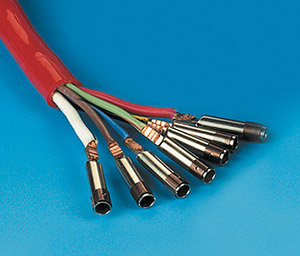
WEST CHESTER, Pa. – With manufacturers using wire harnesses in increasingly challenging functional and environmental conditions, ultrasonic welding is becoming the favored method of assembly, since it produces welds with high conductivity and tensile strength*. In fact, it’s estimated that at least two-thirds of the cabling used in today’s cars is ultrasonically welded.
Wire harnesses are like the central nervous systems for equipment in a wide variety of industries, including consumer electronics and appliances, data and telecommunications, lighting, medical, automobile, marine and aerospace. It’s absolutely crucial that wire harnesses function as required – despite exposure to heat, humidity, vibration, corrosive substances and adverse environments – so good conductivity and guaranteed reliability are essential.
Benefits of Ultrasonic Welding
Ultrasonic welding has become a popular alternative to other methods of welding because it uses vibrational energy to disperse surface oxides and create galling on wire strands. This forms a solid-state metallurgical bond with high conductivity, producing the lowest resistance weld available.
Unlike resistance welding that generates high heat, in ultrasonic welding the metals do not melt, so there are no significant changes in the material properties, and the lower heat means no external water cooling is needed. Also, unlike soldering, which cannot be used if the temperature at the weld during use approaches the melting point of the solder, ultrasonic welding requires no flux or filler materials. Additionally, ultrasonic welding uses much less time and energy than its alternatives.
Achieving an Ultrasonic Weld
The ultrasonic welding process begins with a power supply that converts input line power into high frequency electrical power and transmits that energy to a transducer. The transducer transforms the electrical energy into vibratory energy, which is delivered to the welding area as sound waves, or ultrasonics.
When the vibrating, shear forces of the ultrasonic waves are directed by the welding tip to the interface between two metals, which are held together under clamping force, internal stresses cause deformation where the materials are in contact. A localized increase in temperature and interfacial slip breaks up oxides and surface films, permitting metal-to-metal contact at many points. Continued vibration causes further deformation of the points, increasing the contact area and essentially creating a weld without melting, and producing a metallurgical bond with high conductivity and tensile strength.
Welding Tin-Coated and Oxidized Wires and Terminals
Sonobond’s patented Wedge-Reed Ultrasonic Welding system sets the company apart from its competitors. It uses a vertical vibrating reed, driven by a wedge-shaped coupler and transducer assembly perpendicular to the reed, allowing high clamp force without bending stress or stalling.
Sonobond bonders are the only ultrasonic systems capable of welding tin-coated and oxidized wire and terminals. This enables the machines to be exclusively capable of producing durable welds when tinned wire is required or preferred.
Sonobond Equipment Options
Sonobond offers a variety of ultrasonic metal machines – all made in the U.S.A. – for welding a range of wire bundle sizes, starting at one sq. mm. Most assemblies can be completed in a second or less withminimal operator training.
Sonobond’s Dual Head SpliceRiteTM features welding heads on both sides of the weld area, enabling it to provide one-pulse wire splicing of up to 100 mm2 in stranded bare copper wire and tinned wire to about 60mm2. Also available are a Dual Head Spot Welder, as well as Sonobond’s SonoWeld® units, which can be custom-tooled to weld tinned wire to bare or coated terminals.
Every Sonobond welder is equipped with a microprocessor controller that can program welds by height, energy or time, and store and recall up to 250 jobs. Additionally, all units have heat-treated, taper-lock tips that are capable of achieving up to 100,000 welds and that are easily replaceable without requiring machine readjustment or calibration. Sonobond’s equipment also offers automatic frequency control, overload protection, and can detect and prevent wrong-part or no-part activation.
Order a Free Ultrasonic Welding Viability Test
To ensure that Sonobond equipment can meet your welding needs and assembly specifications, Sonobond offers a free, no-obligation Ultrasonic Welding Viability Test, using customer-provided materials.
About Sonobond Ultrasonics
Founded in 1960, Sonobond Ultrasonics is a pioneering leader in ultrasonic bonding and
welding technology. The company manufactures ultrasonic assembly equipment used by
companies across a broad range of industries, including aerospace, apparel, appliance,
automotive, ballistics, battery, electrical, environmental, filtration, HVAC, medical and solar. With more than 60 years of experience, Sonobond has earned a strong reputation for exceptional customer service and technical support before, during and after equipment installation.
Additional Information
To learn more about Sonobond’s ultrasonic bonding and welding equipment, or for information about the company’s free, no-obligation Ultrasonic Bonding Viability Test, please click this link, call toll free 1-800-323-1269 or contact Sara Karmilowicz at sk@sonobondultrasonics.com.
*Sonobond’s ultrasonic metal welds meet IPC/WHMA-A-620B specifications